
THE ANOMALY
The Anomaly is a short exploration/mystery game and a technical demonstration for
a custom sound and music system made with Unreal Engine and Wwise.
jump to gameplay video and soundtrack
The project shows the first part, of what could lead into, a game centred on the arrival of a mysterious anomaly in a star system. The player follows a trail of clues to investigate the mystery and can explore and uncover pieces of information in whatever order they like (self-guided exploration is one of the key parts of the game).
However, this space-oriented format wasn't what I first went for. Originally, the game revolved around an ancient city in the desert and the disappearance of all its people. The player would explore one of four districts of the city which would have a variety of information pointing the player towards various other locations around the district.
here you can see early prototypes of the desert city format, the first video is a demo of a clue system that fades in audio based on distance. The second video is a more refined version of that but now in first-person perspective with idle/moving music states
Whilst I really liked this idea, and the chance to hone in on the mystery and story I was creating, I was being far too ambitious with my approach. The list of things to do quickly grew longer and longer, and I wasn't enjoying working on the game. I was wanting to go in another direction so I took a page from the biggest inspiration behind this project, Outer Wilds, and brought my game from the desert to the stars with its own unique mystery for the player to solve. This time the focus would be purely on the audio system rather than visuals. (which is why the spaceship looks like a spacetruck, and why there are no trees by the watchtower when there is the ambient sound for them)
THE SOUND DESIGN
As a game composer first, the music side to this project is naturally more developed. However, I still wanted to implement some strong sound design features with a couple of fun interactive sequences in the game.

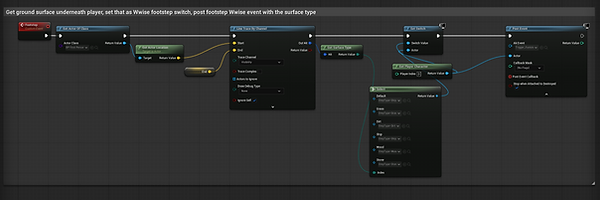
Footstep sounds were directly tied to the player movement animations. In each animation, I added notifiers that triggered a custom footstep event to check what material is underneath the player and play the Wwise footstep sound with the associated material switch

The spaceship thrusters were tied to the movement inputs. Since the movement event is being triggered multiple times (as the key is held down) I used a "Do Once" node to start the thruster sound without it layering on itself infinitely, it gets reset when the movement key is released.
In flight, the player can zero-out their speed pressing X. I made a custom event which fires the thrusters in the direction it would take to bring the ship to a stop.


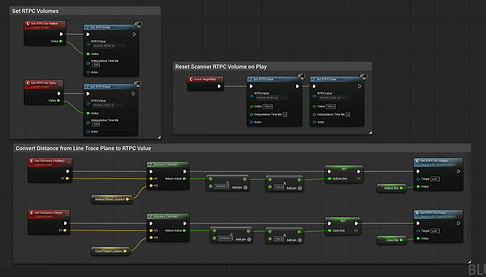
One of the more deceivingly complicated sound effects to implement were the scanner sounds. This was solved by doing a line trace which fades in the scanner volume RTPC when moving to the centre of a plane (seen by the coloured outlines in the video below)
Lastly, there are also atmospheric sounds such as the forest ambience and a campfire sound. In Wwise, the campfire was setup to position the sound based on where the campfire object is whereas the tree ambience was made up of an ambisonic audio file, which in game provides true 3D spatialisation compared to flat 2D stereo files commonly used in games for ambience.
THE MUSIC
The music system uses a combination of area-specific compositions and adaptive music that responds to the player's position in space. The overall sound-world of The Anomaly aims to highlight the exploration and mystery element of the game with cinematic pads and heavy inclusion of ambient guitars, but I also aimed to give each planet its own feel and identity.
The home planet tracks, Awakening and Searching for Signals, have a sense of warmth with the addition of acoustic guitars, banjo and drums that balance against the ambient guitars and ease you in to the mystery.
The Dark Mist composition, Exploring the Mist, is a dense atmospheric track that conveys the claustrophobic nature of the cave planet's tunnels and winding passages (that even got me trapped when recording the gameplay video).
Into the Anomaly is composed for the players first encounter with the Anomaly. I wanted it to sound metallic, unnatural and almost glass-like with distorted and oddly-textured atmospheric drones.
Not all of the music in the project is static tracks. For the space music I wanted to make it adapt and change depending on which planet the player is nearest to. To do this I created smooth transitions from planet-to-space/space-to-planet separating the space music into two layers, a base layer and an additional layer. The base layer acts as the thematic foundation for space, and the additional layers change depending on a Switch set-up in Wwise.

I created this system using a custom Music Trigger blueprint in Unreal Engine (there are one for each planet). When the player enters the blue sphere, it sets the music state to the planet. When they exit, it sets the state to normal. In Wwise this then switches the additional layer to either play the planet specific layer, or one of the normal space layers.
The yellow sphere tells Wwise to start playing the space music/stop it when the player is close enough to the planet.


example of a Music Trigger blueprint which plays/stops space music on entry/exit
Having the additional layers take on the planet's sound palette creates a smoother effect as you move from area to area. In some cases, such as with Dark Mist, hearing the sonic characteristic of the planet before you enter gives a glimpse of what could be inside and therefore a much greater impact when the planet's main track takes over.
INFLUENCES
The Anomaly takes inspiration from a selection of games, each giving me unique ideas and influencing ways sound can interact with the player. As stated earlier, Outer Wilds is undoubtedly the biggest influence for the project. From the start, it shaped the way I thought about exploration when it comes to story games and how freedom of player exploration can work to a game's advantage. The use of music to give character to each planet in Outer Wilds was something I took onboard, and the use of sound (sometimes the lack of sound) creates this incredibly immersive experience.
However, Outer Wilds doesn't feature adaptive music (not in the sense of how I have incorporated it for the space music anyway). That is where the second influence, Journey, comes in. The adaptive music in Journey was created as an accompaniment to the player's exploration of each area. It would guide the player as they travelled across a level, and would adapt to the locations the player chooses to explore (or doesn't). The music also re-loops various instruments and sections of music by adding and removing layers to give a sense of movement and momentum. For my project, I took these ideas for my approach to adaptive space music but since my game isn't structured in linear levels, I instead channelled those concepts to form what would be the planet-specific additional music layer. So in my project, the adaptive music both acts as a way to show movement, through the building and removal of layers, but also helps to enhance the sonic character given to the planets through music.
In terms of visuals, both previously mentioned games have influenced the visual style for different stages of the project. In the first version, the colours and architecture of Journey was an inspiration on how I was planning on build the ancient city. For the current format of the project, whilst there isn't that much of a focus on visuals, Outer Wilds helped to create the rough aesthetic I was aiming for. Perhaps the biggest source of inspiration was the planet Dark Bramble. which is a direct reference for my cave planet, as well as the structure of the journal/rumour map (which I was also inspired from the detective game Shadows of Doubt).
In general, the musical influences for this project came from ambient post-rock bands and artists such as Hammock who is as source of inspiration I always draw from for ambient guitar based soundscapes. More specifically, the use of acoustic instruments in the home planet music was inspired from Outer Wild's track Timber Hearth, as well as Caspian's tracks CMF and Hymn For The Greatest Generation. The tracks for Dark Mist and The Anomaly didn't have set influences, but the overall music I had already composed for the project helped to place the texture and sounds (so that the entire project's music would be cohesive and any track wouldn't feel out of place).
Overall, this project has been incredibly useful for me learning about advanced sound design and music implementation techniques. I am happy with where this project ended up and the music I have composed for it. There is plenty of space for this project to grow, and loads of options for how I could continue this game's story. If there was anything that I feel could be improved, it would be the inclusion of more sound design. However, that wasn't the entire focus of this project as it leans more towards the music side. Perhaps one day I'll return to the ancient city idea, because I still think it has potential, but that's something for future me to think about.